What Is a Firewise Community?
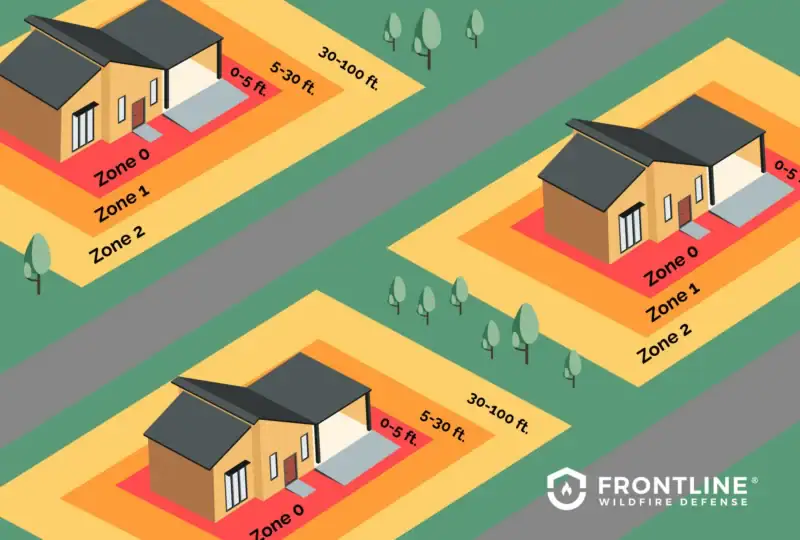
Becoming a Firewise USA® Community involves whole neighborhoods working together to reduce the risk of loss and damage due to wildfire. When wildfires sweep through areas, they don’t just destroy one house. They destroy whole communities. Here, we share insights you can use to make your home and those around you safer and more wildfire-resilient.
Jump to a section:
- What does “Firewise community” mean?
- How do I know if I live in a certified Firewise community?
- The benefits of becoming a Firewise community
- Firewise community requirements
- Can a homeowner start a Firewise community?
- Examples of Firewise community projects
- Firewise communities in California and elsewhere
- Frequently asked questions
- Layered defense: Reducing wildfire risk to communities
What does “Firewise community” mean?
A Firewise community is one that has taken formal and practical steps to create safer homes and landscapes across whole neighborhoods to reduce wildfire risk. Achieving Firewise community certification requires residents to work together through a structured process that starts with planning at the community level and builds on individual actions that each homeowner can take to make their home fire-resilient.
Neighborhoods can work together informally, but they may prefer to make their efforts official through Firewise USA®, an initiative of the National Fire Protection Association (NFPA). The project provides guidance through its structured mitigation practices and process, along with resources to help communities achieve their fire-resilience goals.
In addition to reducing wildfire risks and enhancing safety, communities may enjoy financial benefits. Possible outcomes of becoming a Firewise community include higher property values, easier resale, and the potential to impact the availability and cost of insurance.
How do I know if I live in a certified firewise community?
You can find Firewise communities in California and across 40 states coast to coast. To find communities in your state, there are several places to look:
- Firewise map: The NFPA’s Firewise USA® provides an easy-to-use map.
- Firewise community list: The NFPA’s site includes a reasonably up-to-date state-by-state list of communities with Firewise community certification.
- Local authorities: It’s possible your community is still working through Firewise community requirements or has only recently completed them. Contact your local authorities. Your fire department is a good place to start.
- Homeowner’s association (HOA): If you own a property covered by an HOA, you may wish to contact its leadership.
The benefits of becoming a Firewise community
Wildfires are an area-wide emergency, threatening not just individual homes but also the very fabric of a community. More areas are exploring how to work collectively to become a Firewise community. A community-wide approach reduces everyone’s risk and brings significant benefits.
First among these is the reduction of wildfire risks. When residents and leaders work together to increase defensible space, invest in fire-resistant landscaping, and plan for emergencies, the chance that homes, schools, businesses, and institutions will suffer wildfire damage is much lower.
Coordination improves preparedness, awareness, and safety. People working together to take on a major challenge creates a feeling of shared responsibility.
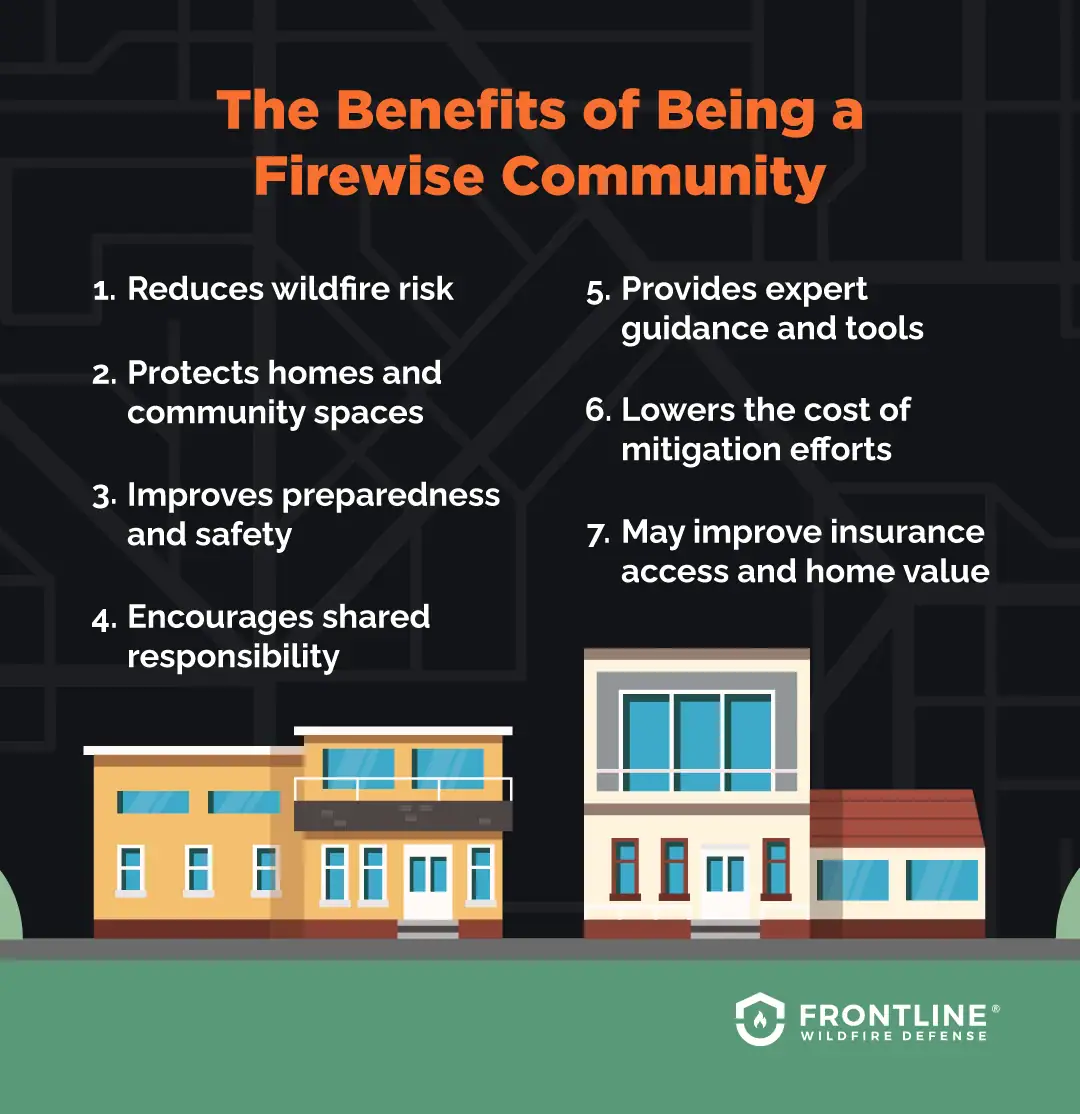
Working with Firewise USA® provides neighborhoods with a wealth of expert advice, planning templates and tools, implementation support, and access to wildfire mitigation best practices. Neighborhood groups also help connect homeowners with trusted, effective solutions like Frontline Wildfire Defense, and they may offer referral incentives when neighbors participate.
When your area meets the Firewise community requirements and achieves Firewise community certification, you may also enjoy benefits like lower insurance costs, improved access to insurance, and higher resale value.
Firewise community requirements
The Firewise USA® program provides a clear process and rich national, state, and regional resources designed to help neighborhoods reduce wildfire risks and improve emergency readiness. Firewise guidelines for certification address different levels, from individual homeowners to entire neighborhoods, and engagement with organizations at the municipal, county, and state levels.
Firewise works with a variety of such organizations. It provides local expertise, support, and implementation assistance to communities seeking to get certified as a Firewise site. FireSafe Marin in California, Boulder County Wildfire Partners in Colorado, and Texas A&M Forest Service are examples of the reach and variety of Firewise support organizations.
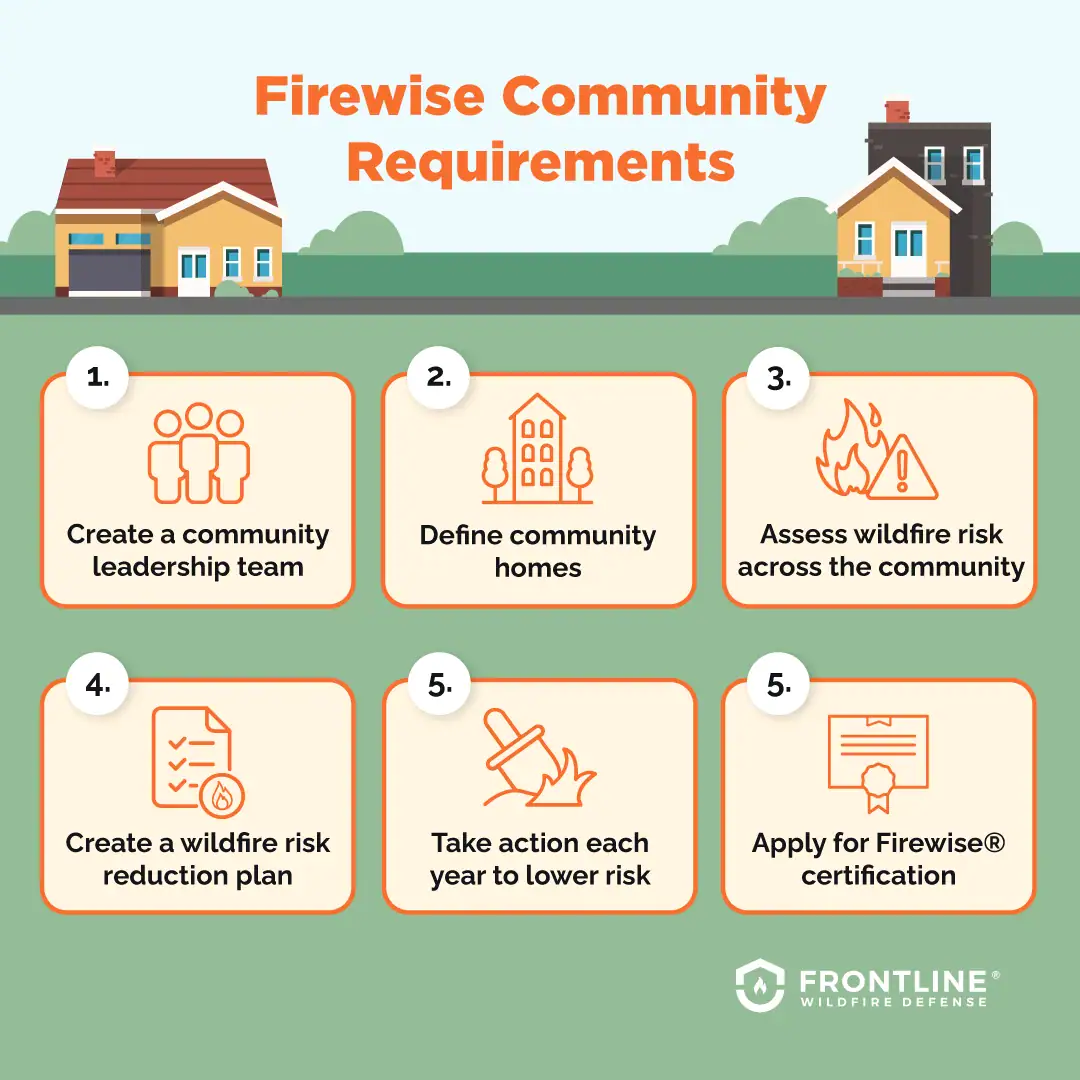
Here’s how to become a Firewise community.
1. Form a community board or committee
Gather a small group of like-minded residents to lead the effort to become a Firewise community. Look for people with the energy, time, skills, and commitment to organize meetings, keep progress on track, and effectively communicate with all stakeholders.
2. Define the number of dwelling units
Set geographic boundaries for your community and identify the number of homes within it. Firewise has a minimum of eight dwelling units and a maximum of 2,500. You want a community that’s large enough to work collectively but small enough to be manageable.
3. COMPLETE A COMMUNITY WILDFIRE RISK ASSESSMENT
Identify the hazards and vulnerabilities in your community. Prioritize what must be addressed to lower these risks. The program and local partners can provide step-by-step guidance on what to include and how to identify hazards with checklists, worksheets, and other helpful resources. You will need to reassess your community at least every five years.
4. DEVELOP AN ACTION PLAN TO REDUCE WILDFIRE RISK
Use the risk assessment to generate a plan that lays out the specific steps your community will take to address the hazards and vulnerabilities you have identified. The plan will align residents around clear shared goals and will help you use resources wisely. As with the risk assessment, Firewise and its partners offer rich resources to help with this step.
5. CARRY OUT ANNUAL RISK MITIGATION ACTIONS
Demonstrate the ongoing commitment of your community to lower risks and strengthen your area against wildfires. Execute on your plan, performing at least one meaningful task a year. Example tasks include managing vegetation and clutter, holding educational events, updating evacuation routes and emergency vehicle access plans, and installing community-wide wildfire defense systems.
6. APPLY FOR FIREWISE® CERTIFICATION
Apply to Firewise USA®. You need to document your risk assessment, action plan, and mitigation efforts. When you have met the Firewise Community requirements and your application is approved, you will be awarded a Firewise community certification and have the right to display Firewise USA® signs around the community. Maintaining your status as a Firewise community requires renewing your application every year.
Can a homeowner start a Firewise community?
Yes, individual homeowners and residents are at the heart of Firewise communities. What makes the initiative so effective are the grassroots efforts of people who live in and have the greatest stake in each neighborhood.
By working with fire-safe organizations and other Firewise USA® partners within the framework, individuals can achieve significant improvements in risk mitigation. They take the lead in the initial organization of committees and drive all activities to achieve and maintain Firewise community certification.
Examples of Firewise community projects
Strengthening neighborhoods against wildfires is a multilayered effort that takes commitment and has no end date. Firewise communities take on a new way of life, engaging residents in a range of projects that establish a fire-resilience baseline and build on it over time. Grants are available to help communities fund their work.
Some common examples of projects Firewise communities take on include:
- Collaboration with experts: Taking advantage of the depth and breadth of expertise available ensures Firewise communities adopt best practices and get the most benefit from their efforts. Partners bring expertise from forestry professionals, fire departments, wildfire mitigation specialists, and others to every element of the program.
- Outreach and resident education: What really makes the program work is engagement, which requires communication, education, and planning. Workshops, meetings, newsletters, and task forces get people involved in improving neighborhood fire resilience. Outreach can initiate the coordination of homeowners seeking advanced protection options like the Frontline Wildfire Defense System.
- Home hardening: Preventing an individual home from catching fire helps protect surrounding homes. That’s why it’s important to encourage upgrades with fire-resistant materials and designs, such as ember-resistant vents, fire-resistant roofing and siding, enclosed eaves, and tempered windows that resist shattering in high heat.
- Defensible space and landscaping: Neighborhood fire risks extend beyond property lines. Communities can work together to remove dry vegetation that can fuel fires, create defensible space landscaping with widely spaced native plants that are fire-adapted, and prune trees in public spaces.
- Neighbourhood projects: Organizing clean-up days is a great way to bring attention to Firewise community initiatives. It’s also a way to engage neighbors and make a meaningful contribution to the fire resilience of any area. Removing roadside brush and trash, sprucing up common areas, and performing general upkeep and repairs reduce the risk of ember ignition throughout the neighborhood.
Firewise communities in California and elsewhere
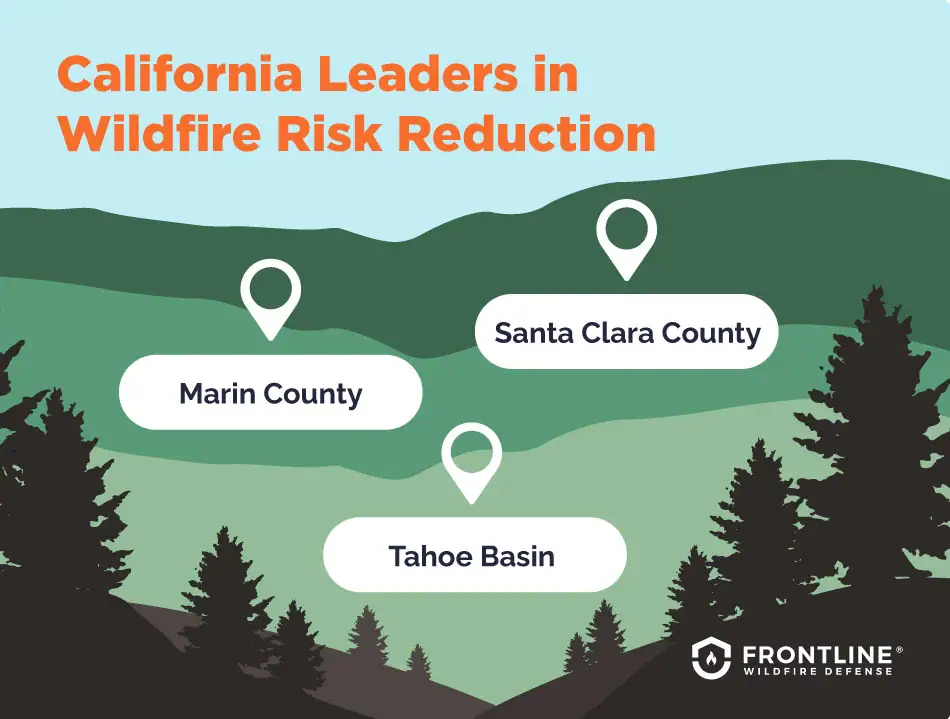
Numerous Firewise communities have already been established in California and other states. For example, in the Tahoe Basin, Al Tahoe and Cascade Properties lead a robust program of wildfire mitigation activities.
Santa Clara County is another leader in reducing the wildfire risk to communities, especially when it comes to incorporating advanced wildfire prevention technologies on homes:
“Our partnership enables us to make Frontline’s systems available, deepen our community impact, and give our clients access to leading wildfire early detection solutions to protect their homes, communities, and environment from wildfires,” said Seth Schalet, CEO of the Santa Clara County FireSafe Council.
FAQs
WHEN WAS THE FIREWISE PROGRAM FIRST ESTABLISHED?
The concept of a Firewise community got its start in the late 1980s. Wildfire professionals recognized that the problem of wildfires was too wide-reaching and multilayered to leave to fire departments alone. Engaging homeowners in community-wide action was the key to reducing wildfire risks.
The Firewise program brought together research and education efforts in the first shared approach in 1988. It was adopted, formalized, and expanded by the NFPA in 2002 under the name Firewise USA®. It has rapidly expanded nationally since then.
HOW MANY FIREWISE COMMUNITIES ARE THERE?
Tens of thousands of neighborhoods have achieved Firewise community certification since the program started. Areas in states with the greatest wildfire risk to communities were the first to meet Firewise community requirements.
With the growing awareness that nearly any community could experience a wildfire emergency, more neighborhoods have adopted community-based wildfire mitigation approaches. Every year, more communities have joined, and existing sites have renewed and strengthened their commitment.
HOW DOES A COMMUNITY MAINTAIN ITS FIREWISE STATUS?
Firewise communities must document compliance with Firewise community requirements annually. Wildfire risk mitigation takes ongoing effort. Clearing flammable brush from public areas is of little value if it is left to grow back the next season.
Maintaining a community’s Firewise status is all about maintaining a community’s risk mitigation efforts. Annual renewals document ongoing work and serve as an opportunity for your neighborhood to get feedback, advice, and practical help in improving fire resilience.
WHO SHOULD BE PART OF MY FIREWISE COMMUNITY?
Building the leadership and working core for your Firewise community involves picking the right people and engaging with the right partners. Homeowners, neighborhood leaders, HOA staff, and other stakeholders are ideal groups for recruiting members.
Consider involving your fire department, fire safe councils, and other local and regional Firewise partners, along with forestry agencies if your community is in a rural and wildland-urban interface area. Keep your committee small enough that you’re able to move quickly. Choose motivated and skilled people who will carry the weight of the work.

Layered defense: Reducing wildfire risk to communities
Wildfire resilience requires taking a layered approach to defending your property and surrounding areas from wildfires. Firewise communities play a key strategic role in reducing the risk that wildfires pose. Community-wide planning and risk mitigation activities work hand-in-hand with the efforts of individual homeowners.
Hardening your home, clearing defensible spaces, and adding active defense technologies like roof and property sprinkler systems are all layers that reduce the risk of losing a home or neighborhood to a wildfire. The coordinated efforts of individuals and neighborhoods to layer defenses demonstrate the idea of the whole being stronger than the sum of its parts.
Ready to explore how Frontline’s wildfire defense systems can protect your property or community?