Why a Truly Fireproof Home Isn’t Possible
Although the goal of many homeowners is to have a fireproof home, this isn’t actually possible. Anything will burn in the right circumstances. Wildfires are a complex and unpredictable force of nature that no single type of material or design choice can defeat.
What is possible to achieve is fire resilience. In this case, the goal isn’t to defeat fire but to live with it. By adopting specific home designs, building materials, and landscaping decisions that resist ignition, you can slow the spread of a fire and recover more quickly afterward.
Resilience starts in Zone 0, the five-foot perimeter around your house where embers pose the greatest risk. Eliminating combustible materials from this area is the first step (or layer) in creating a fire-adapted home. Experts recommend a layered fire-resilient strategy that uses science-backed approaches to reduce the risk of wildfire at multiple levels.
Jump to a section:
What does “fireproof” really mean?
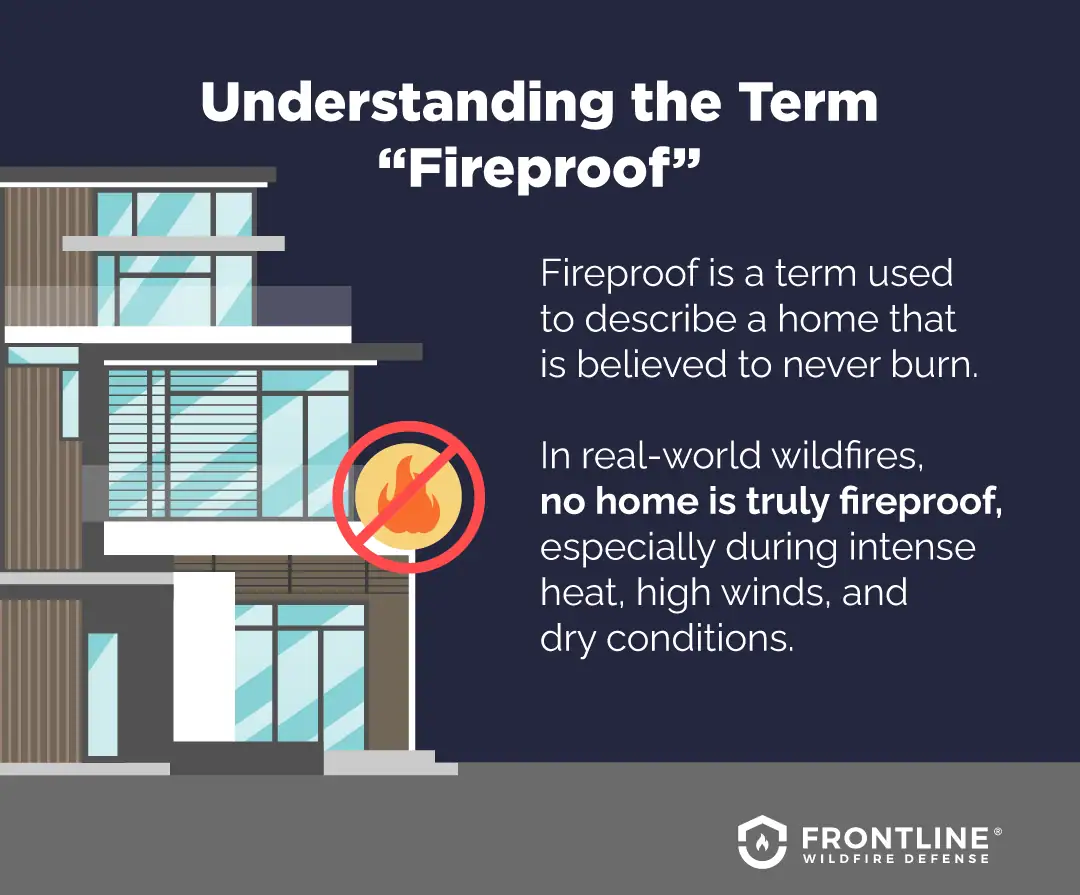
Many people think that a fireproof home is one that won’t burn under any circumstances. While it’s a desirable concept, fireproof houses don’t exist in the real world.
When you hear the term “fireproof,” it’s usually used as a marketing tactic, not a scientific standard you can depend on. Under extreme heat, such as intense fires driven by high winds or fueled by prolonged dry conditions, even the most fire-resistant materials can burn.
When searching for ways to save your home, knowing the answer to the question, “What does fireproof mean?” can help you understand how to achieve a high level of protection. While you cannot completely eliminate the risk of a wildfire damaging or destroying your home, you can take a layered approach to effectively make it as fire resistant as possible.
Is a truly fireproof home possible?
Achieving a completely fireproof home is impossible. Any material will eventually fail under extreme heat, even concrete. For instance, the Robert Bridges House in the Palisades was a famous example of brutalist architecture constructed from heavy concrete and steel. Despite the fact that these materials are extremely fire resistant, the house was destroyed in the January 2025 Palisades Fire.
While fire-resistant materials and resilient design strategies can greatly reduce risk, no building can be made entirely fireproof. Trying to achieve this would mean living in something close to a bunker, sacrificing cost, comfort, and appearance without truly eliminating fire risk.
That said, there are steps you can take to protect your home and improve its resilience. Layering fire-resistant home design and materials, using passive fire protection measures, and employing active fire defense systems all help reduce the risk of a wildfire destroying your property.
What’s the difference between fire resistant and fireproof?
Fireproof implies that a material is immune to fire and won’t burn under any circumstances. In contrast, fire resistance is a measurable scientific concept. To prove this concept, materials undergo tests to determine how long they can withstand exposure to a direct flame and high heat before they fail or catch fire.
However, even fire-resistant materials have limits, and real-world wildfires present challenges that these tests don’t capture. For example, what isn’t measured is how well a building reacts to wildfire embers. Many homes can still burn in a wildfire when embers ignite debris around the property, fall into small exterior gaps on the house, collect on roofs or under eaves, or enter through vents.
Instead of asking what material is fireproof, you should ask how well your house will withstand exposure to a wildfire. Building for fire resilience vs. building with fire-resistant materials means taking a comprehensive, layered approach to protecting your property.
This approach starts with the materials used in building and landscaping, but it goes further. It involves designing buildings that minimize the risk of embers starting a fire. It includes creating a defensible space around your house and maintaining practices that limit fuel and the possibility of a fire taking hold on your property. It can also entail active defense measures that create an environment that’s too wet to burn.
Fire ratings and standards homeowners should know
Rather than being swayed by marketing language around fireproofing, focus on fire ratings and standards. These metrics indicate how well a given material can resist fire under tested conditions and provide a clear, objective measure of its performance.
Fire-resistance testing measures the ability of a material to withstand heat. Testing specifically determines how well materials keep their structural integrity when exposed to heat and flames. These tests also measure how well the material contains a fire, restricts its spread, and limits the impact of heat and smoke.
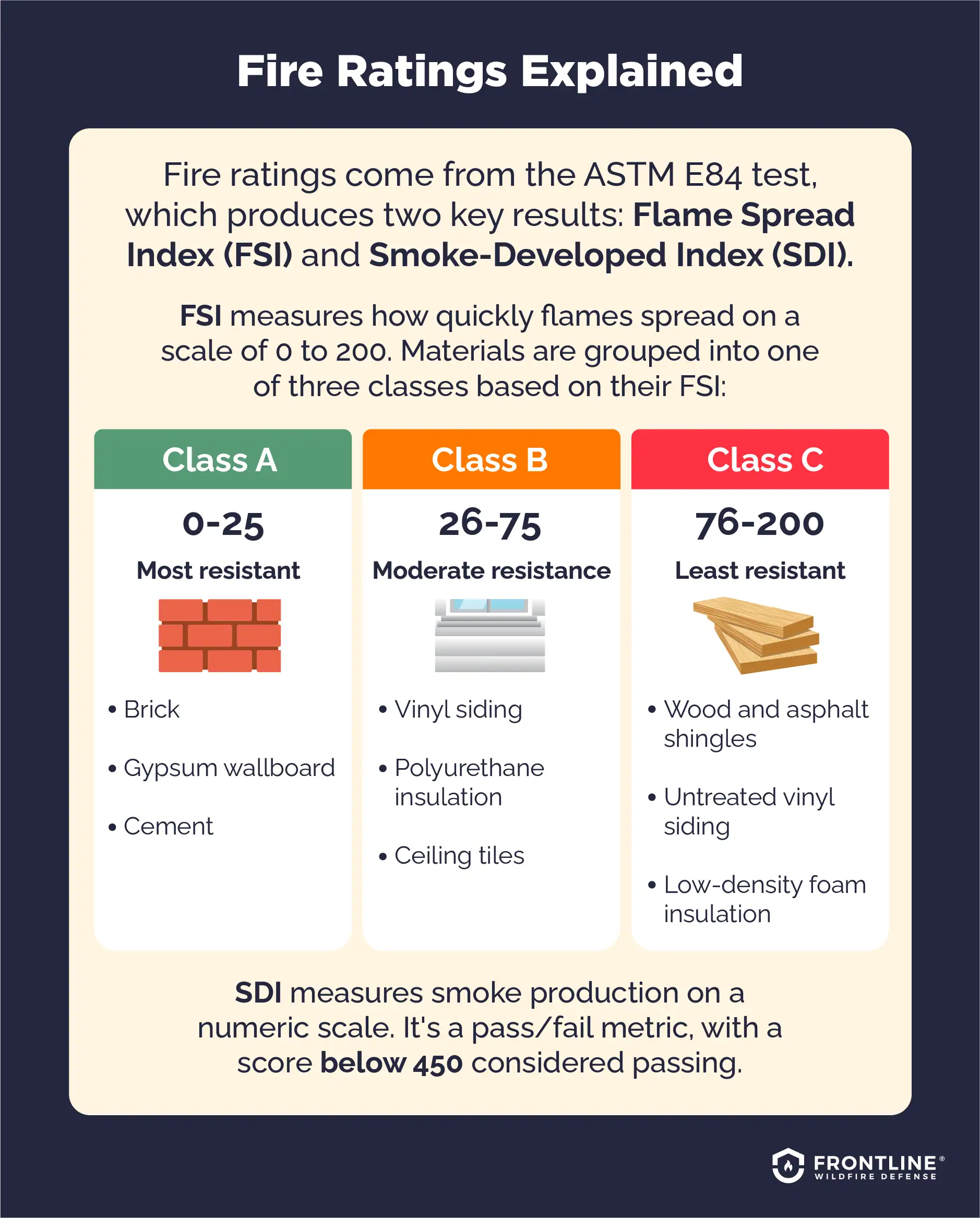
Fire ratings come from the ASTM E84 test, which produces two key results. The main result is the Flame Spread Index (FSI), which shows how quickly flames spread. It’s measured on a scale of 0 to 200, with lower numbers indicating slower flame spread. Building materials are grouped into classes based on their FSI, with Class A (0-25) being the most resistant, Class B (26-75) moderate, and Class C (76-200) the least resistant.
The second result is the Smoke-Developed Index (SDI), which measures smoke production. SDI is a pass/fail metric, with a score under 450 considered passing.
- Class ratings for surface burning characteristics: One key rating relates to how quickly the surface of a material spreads flames and produces smoke and other gases. As noted above, the ASTM E84 testing method is an international science-based standard for this evaluation.
- Time ratings for assemblies: Assemblies are systems made up of several building materials, such as roof underlayment, decking, and shingles. A time rating for an assembly measures how long it can be exposed to fire before failing. This is the most common fire rating, as so many parts of a building consist of assemblies.
- Construction type ratings: It’s also common to rate an entire building. The roof, walls, floor, windows, and other structural components are tested for their ability to withstand fire.
Fire rating classifications
The results of testing indicate a rating for flame spread and smoke, which places materials into a specific class. Building codes typically specify materials with specific minimum fire ratings. The lower the number, the better.
- Class A: These materials are the most fire resistant and have a flame spread rating of 25 or lower and a smoke development rating less than 450. Examples include brick, gypsum wallboard, and cement.
- Class B: Materials in this category have a flame spread rating between 26 and 75 and a smoke development rating under 450. Examples include polyurethane insulation that’s been treated with fire retardant, as well as treated ceiling tiles and vinyl siding.
- Class C: Materials that rate between 76 and 200 for flame spread while still keeping a smoke development rating below 450 fall into this class. Examples include wood and asphalt shingles, untreated vinyl siding, and low-density foam insulation.
Practical steps to build a safer home
Achieving a 100% fireproof home isn’t realistic, but there are areas you can focus on to improve the odds that your home will survive a wildfire. The following science-backed tips are part of a layered defense against the threat of wildfires:
- Install Class A roofing: Roofs are the part of a structure that are most at risk of damage due to flying embers in a wildfire. Use roofing materials with the highest fire-resistance ratings possible.
- Look for one- to two-hour fire-resistance ratings: This applies to walls, doors, windows, and other penetrations. Heat can shatter glass and deform doors that have poor ratings, putting your whole home at risk.
- Choose ember-resistant vents, soffits, and gutters: Models with UL/ASTM certifications are better at keeping embers out.
- Use noncombustible siding and cladding: Ignition-resistant materials treated with fire retardant may not withstand the harsh conditions of wildfires as well as fiber cement, stucco, or masonry.
- Choose noncombustible materials for decks and fences: Build decks and fences using noncombustible or ignition-resistant materials, and separate them from the house where possible to reduce the risk of fire spreading.
The role of water and foam in fireproofing a home
Water helps protect homes from fire because wet materials are harder to ignite and burn more slowly.
Adding a water-based layer of defense, such as exterior sprinklers or Class A fire prevention foams, can douse embers, slow fires that do start, and reduce heat buildup near your home. These systems protect roofs, soffits, eaves, siding, and surrounding landscaping.
Paired with fire-resistant materials, thoughtful building design, and well-maintained defensible spaces, these active protection systems greatly enhance a home’s overall fire resilience.

FAQs
WHAT MATERIAL IS USED FOR FIREPROOFING?
No material can completely fireproof a house. In the right conditions and temperatures, any material can burn or melt, including steel and concrete. The better approach is to build with fire-resistant materials and use fire-resilient design choices and building methods. For example, use Class A roofing materials, such as concrete, clay tiles, or metal, along with stucco, fiber cement, and masonry for siding. Tempered glass is also less likely to shatter in high heat.
IS ANYTHING 100% FIREPROOF?
No, the idea of fireproofing is a marketing concept, not reality. Everything burns when the fire is hot enough and burns long enough. The practical goal is fire resilience. Use fire-resistant building materials, coupled with design choices that reduce the risk of embers setting your house on fire in the first place.
From there, perform regular maintenance to keep your property in good repair and to make sure that you maintain a defensible perimeter, free of clutter and combustible materials, around your house. Pay particular attention to the area that’s at least five feet wide around your house, called the Zone 0 perimeter.
IS FIREPROOFING REQUIRED IN CALIFORNIA?
No, fireproofing your house is not mandated by the state. California enforces increasingly detailed and strict building codes and regulations, designed to reduce the risk of loss in a wildfire. The state encourages fire-resilient homes, neighborhoods, and communities through these standards and works hard to educate homeowners, architects, and builders on the latest fire-resilient best practices.
Requirements vary by location, with homes in wildland-urban interface areas and those recovering from past fires often needing to comply with more rigorous codes when building. The state is investing in learning more about defensible space standards, fire-resistant materials, and fire-resistant building design practices.

Layered defense: Combining materials, design, and active systems
No single material or strategy can fully fireproof a house. Real protection comes from layering fire-resistant building materials, resilient design and smart maintenance habits. This combined approach far outperforms relying on any one tactic.
The Frontline Wildfire philosophy shifts the goal from defeating fire to living safely with it, emphasizing practical strategies over wishful thinking. Adding an active defense system, like exterior wildfire sprinklers, can stop or slow fires and limit potential damage to your property.
Take the first step toward a safer, smarter, and more wildfire-resilient home today.