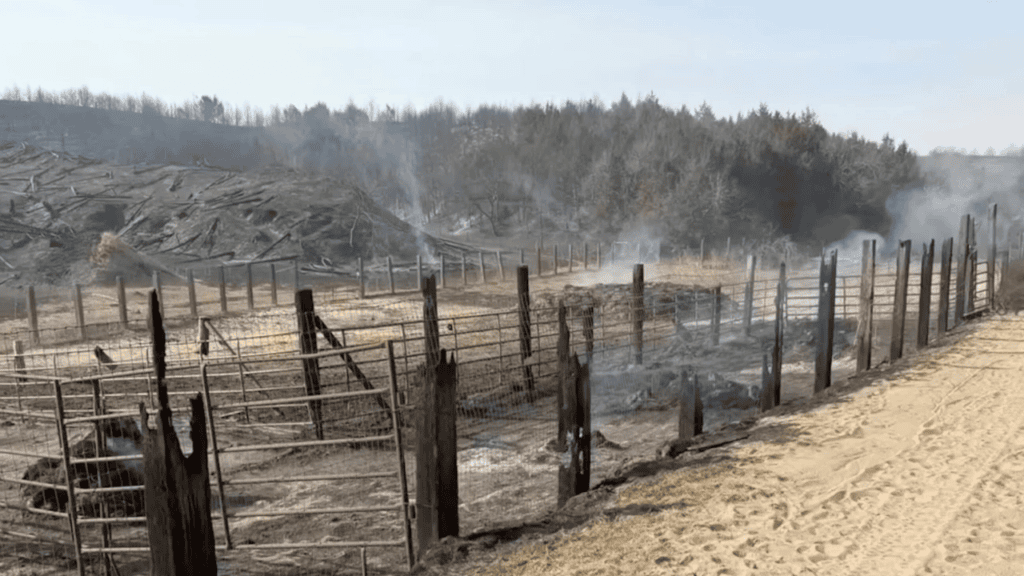
In the middle of March this year, Nebraska experienced one of the largest wildfire events in its history.
On March 12, a combination of 70-mph winds, record-high temperatures, and extreme drought led to the ignition of several major wildfires. By March 13, Governor Pillen had declared a state of emergency. Before the week ended, over 827,000 acres had burned, surpassing the state’s previous 2012 record for an entire year in just a matter of days. The Morrill Fire alone became the largest single wildfire in Nebraska history.
“If you have hurricane force winds, like we’re seeing today in Nebraska, embers can go up to 24 miles outside of the wildfire perimeter,” Frontline’s founder Harry Statter told Cowboy State Daily.
In Nebraska, this reality played out in real time. Driven by fierce winds reaching 70 to 80 mph, embers and colliding power lines ignited dry fuels. While local volunteer departments were quick to react, they were immediately spread thin across vast rural ranch roads.
“It’s not if your property is going to face fire. It’s when.” Statter continued. “When all of your neighbors face the same fire or your entire community faces the same fire, firefighters are quickly overwhelmed. And the reality is, firefighters are focused on saving your life. They’re not focused on saving your property. So you have to take matters into your own hands.”
No system is equipped to save lives and defend property across hundreds of thousands of acres simultaneously.
While the impact of a fire is often measured in homes lost, the agricultural toll in Nebraska tells a long-term story that affects the land and businesses that depend on it. Economic losses are estimated to exceed $150 million in infrastructure and livestock. More than 35,000 cattle were displaced, thousands of miles of fencing were destroyed, and grazing land was effectively eliminated for the 2026 season.
In the immediate aftermath, ranchers have no land for surviving cattle to graze. Alternatives like shipping in emergency hay come at a high cost, on top of already significant losses. Long term, it will take years to rebuild miles of fencing and infrastructure like windmills, stock tanks, and calving sheds. And for the land itself, restoration will require years of soil stabilization and invasive species management.
These fires are a reminder of the reality we’re in. Wildfire risk is increasing and communities can’t just relocate out of its path. In places like Nebraska, their land represents both a legacy and livelihood. Recovery will happen but, when a fire moves through at this scale, the timeline stretches for the communities and economies around them.
Across the country, we are shifting from simply reacting to fire to now planning for it. In fire-prone communities, long-term resilience will depend on our ability to adapt and protect what we’ve spent generations building. By hardening structures and implementing active defense systems, we can protect communities and the people who depend on them.
More from the Frontline Blog
All Posts
When living in a wildfire-prone region, protecting what matters most requires more than just standard preparation. Golden Bear Solar...
A Massive Gap in Passive Structure Hardening Virtually every wildfire expert agrees that wind-driven embers are the primary threat...

Every homeowner’s journey with Frontline begins with a conversation. For many, that conversation comes after experiencing a wildfire firsthand,...