A Massive Gap in Passive Structure Hardening
Virtually every wildfire expert agrees that wind-driven embers are the primary threat to homes. This realization has driven massive progress in how we prepare. Homeowners are investing in home hardening and defensible space. Upgrading to fire-rated roofing, dual-pane tempered glass, and ember-resistant vents makes a home fundamentally more resilient. These passive upgrades do exactly what they were engineered to do: prevent stray embers from finding an easy way inside.
However, modern wildfire science highlights an important reality: building materials are static, but everyday living is dynamic. There is a gap in protection between the fuels that are igniting around the home, and the ability for that home to protect itself using only passive mitigations.
When we look at how homes actually catch fire in residential neighborhoods, the primary threat often isn’t the forest. It’s everyday non-attached fuels sitting just feet from our walls. The good news? Once you understand how these fuel sources behave, managing them becomes a solvable engineering challenge.
The Physics of Everyday Fuel
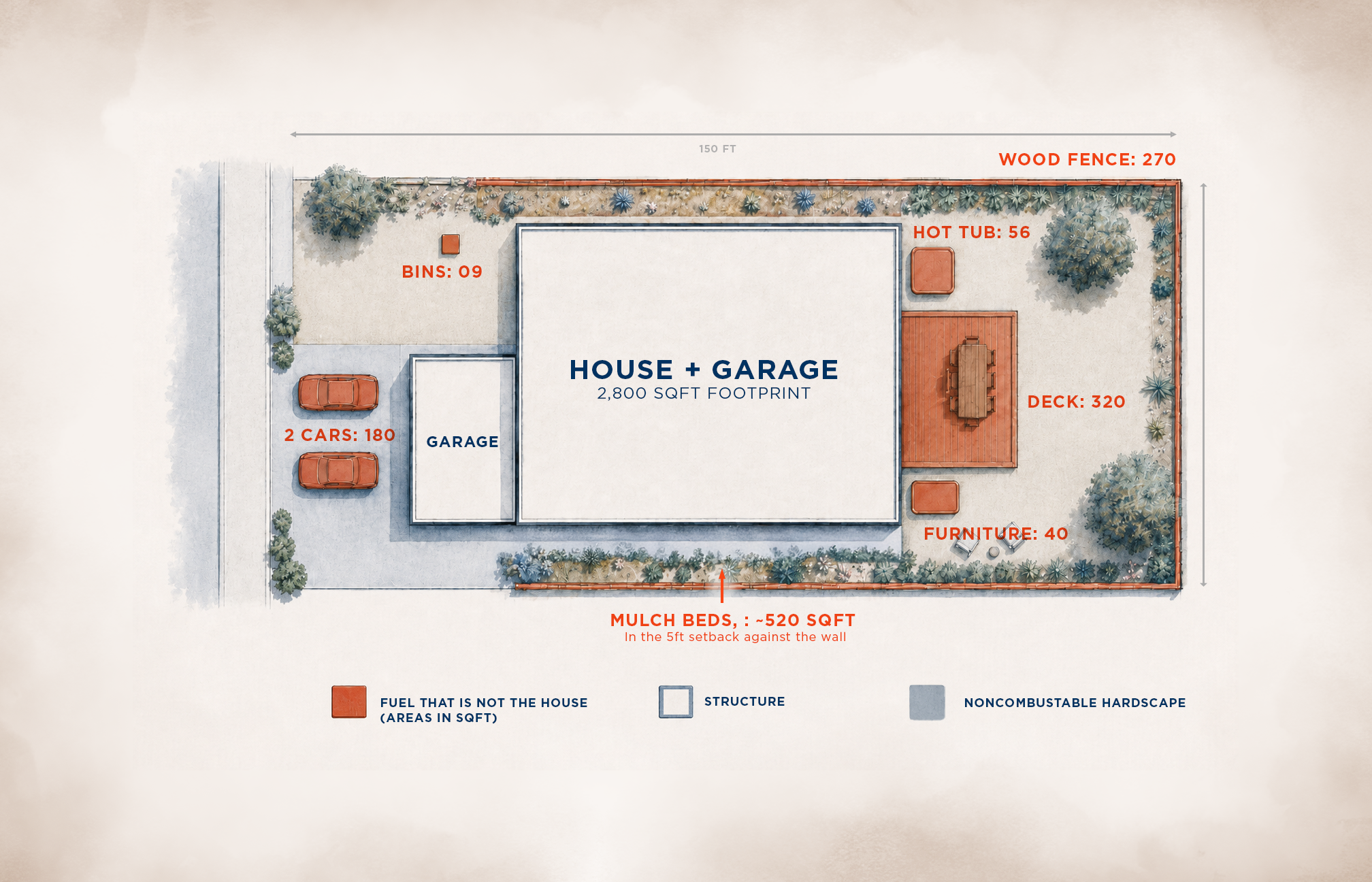
On any lived-in property, there are “non-attached fuel packages.” Or simply put, any combustible item resting on a property that isn’t built into the house itself like outdoor furniture on the patio, cars in the driveway, covered hot tubs, or wall-mounted batteries.
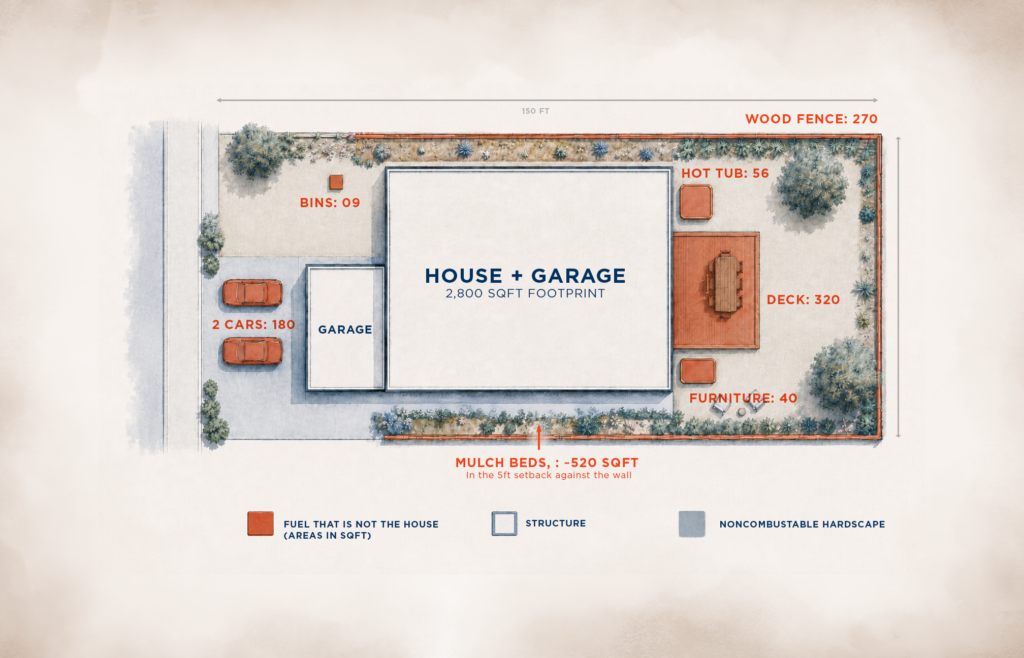
* Based on lot spatial modeling using Census footprint data, roughly 25% of a typical yard area is covered by non-attached combustibles (NAHB Eye on Housing / Census Bureau). When fire scientists calculate the total fuel load on a property, they find that nearly one-fifth of everything that can burn sits outside the house itself (JRC Eurocode Handbook 5 / RISE Research Institutes of Sweden).
Static Code vs. Real-World Fuel
The physical reality is that, when these non-attached items catch fire, many everyday yard items produce far more heat than what static building codes test for or fire-upgraded materials are built to withstand. The table below compares the heat output of common fuels against standard home limits:
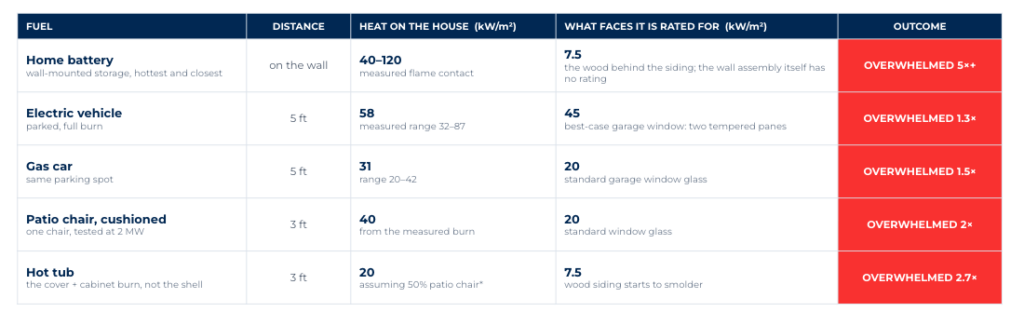
*Data source: Frontline Wildfire Defense analysis “The output of heat is higher than the rating for many common fuels” – kW/m² is fire heat per square meter: wood smolders near 7.5, standard glass fails near 20, best tempered panes near 45 kW/m2. (compiled from NIST, UL FSRI, and NBS fire testing literature)
To put the data into perspective, consider two examples:
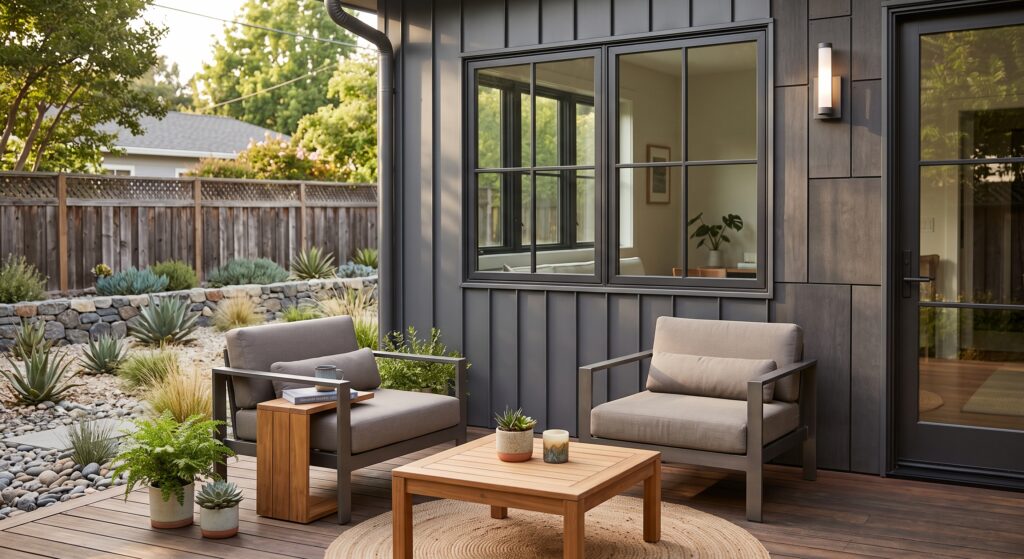
The Patio Cushion vs. The Window: Because outdoor furniture needs to withstand rain, sun, and wear, those cushions are typically made of heavy-duty synthetic materials designed for durability. When enough embers land on one of those cushions and ignites it, the resulting fire generates an intense amount of thermal energy. A synthetic cushion burning three feet from a window generates 40 kilowatts of heat (NIST / NBS Upholstered Furniture Study) which is double the heat needed to shatter standard glass (UL FSRI Window Failure Study). Even with fire-rated tempered glass, that level of radiant heat can ignite curtains and furniture inside before the window ever breaks.
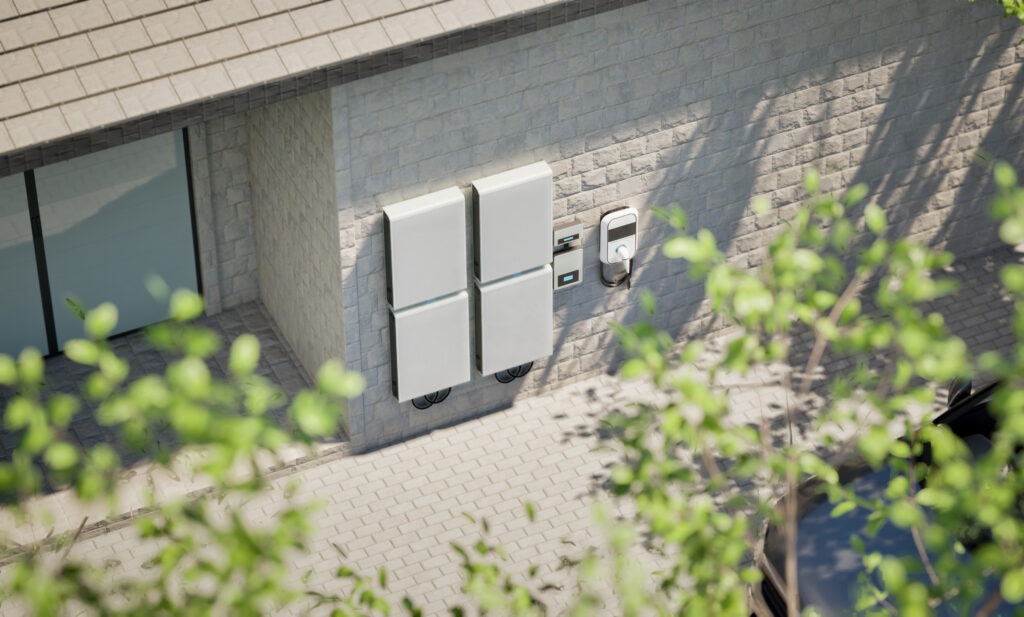
The Home Battery vs. The Siding: Most home battery systems, like a Powerwall, are mounted directly to the garage wall. The siding might resist a windblown ember but it cannot stop intense heat from transferring through to the wood framing inside the wall. If a wall-mounted battery ignites, it can create between 40 and 120 kilowatts of direct heat (IAFSS Wall Fire Heat Flux). That overpowers the wall’s underlying structural protection by more than five times (NIST Ignitibility of Structural Wood Products).
Everyday Items Can’t Always be Moved
It’s easy to ask, “Why not just move these items before a fire?” Wildfires move quickly and when an evacuation order comes, getting your family to safety is the only priority. Families gather essential supplies, grab meaningful keepsakes, and leave quickly together. Second cars remain in driveways and permanent fixtures like hot tubs or energy storage units can’t be moved at all. If you’re already away from home, you can’t risk your life to haul heavy furniture inside.
Layering Protection: The Power of Active Defense
Understanding how non-attached fuels behave doesn’t mean passive home hardening isn’t working. Certain aspects of passive mitigation play an essential role by stopping windblown embers from getting inside the structure or from igniting small fine fuels around these larger objects.
Nevertheless, everyday life naturally adds extra fuels to a property and that’s just a given. We don’t need to live in fear or change how we live at home. We just need strategies that react to how fire actually behaves in a lived-in neighborhood.
True wildfire resilience relies on a complete, layered approach:
- Defensible Space reduces fuel loads from surrounding vegetation.
- Passive Hardening replaces vulnerable building materials with ember-resistant ones.
- Active Defense responds when it matters most, keeping structures and surrounding objects too wet to ignite as well as cooling exterior materials.
Where passive materials attempt to resist heat, active systems work by removing the heat. Active defense systems strategically apply targeted hydration to avoid the ignition in the first place.
Ultimately, protecting a modern home requires both smart passive design and the right technology to engineer around real-world risks. By combining the two, we bridge the gap between static material ratings and real-world fire physics. Which gives us more control and real peace of mind to living in wildfire country.
Sources & Methodology
- Lot & Yard Fuel Estimates: “Single-Family Home Size, Q2 2025” NAHB Eye on Housing / Census Characteristics of New Housing. “Design of Buildings for the Fire Situation” JRC Eurocode Handbook 5 (EN 1991-1-2 Annex E).
- Furniture & Cushion Heat Release: “Upholstered Furniture Heat Release Rates” Babrauskas, Lawson & Walton, NBS (now NIST), 1982.
- Wall-Mounted Battery Radiant Heat: “Wall Fire Heat Flux Measurements” Back, Beyler, DiNenno & Tatem, IAFSS, 1994.
- Window & Siding Resistance Thresholds: “Window Pane Failure During Exterior Fire Exposure” Willi, Gorham & Horn, UL FSRI, Fire Technology, 2025. “Ignitibility of Structural Wood Products” NIST TN 2153, 2021.
More from the Frontline Blog
All Posts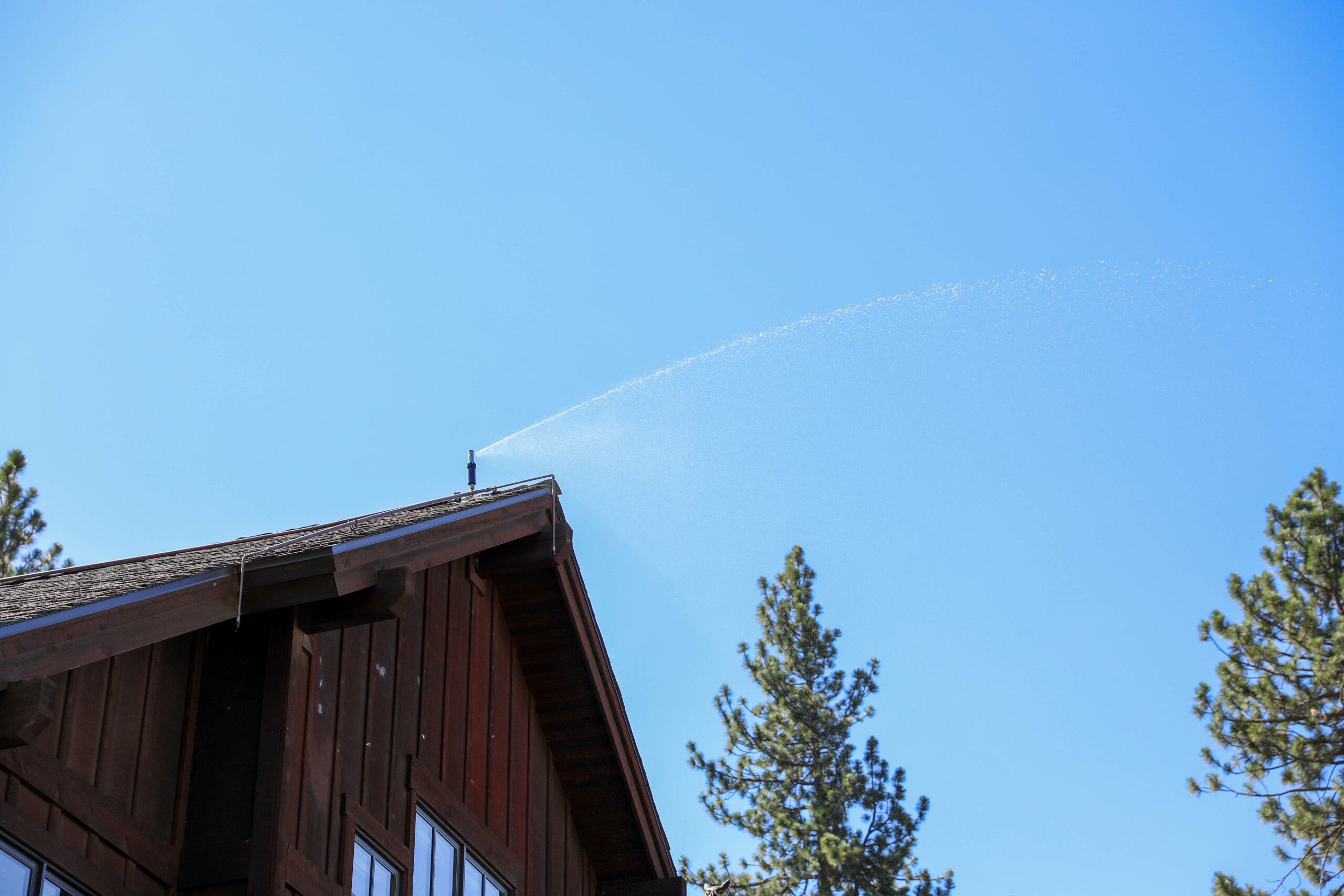
When living in a wildfire-prone region, protecting what matters most requires more than just standard preparation. Golden Bear Solar...

Every homeowner’s journey with Frontline begins with a conversation. For many, that conversation comes after experiencing a wildfire firsthand,...

Technology is changing what’s possible in wildfire protection. Now the challenge is helping people reimagine what’s possible and that’s...